Day trips from Basel: Augusta Raurica, Arlesheim, Colmar, Freiburg and what fits into one day
From Basel, a lot is "under an hour" away, but hardly anything is half a day. Which trips work as half days, which need a full day, which tickets apply and which combinations fail.
Basel Tourism lists Colmar and Freiburg among destinations less than an hour away, and Lucerne, Bern and Zurich among those one to two hours away. That is true of the train from station to station, but not of the trip itself.
On top come the way from your hotel to the station, waiting time, a change and the walk from the destination station into the centre. This page therefore works with door-to-door times, says how much time on site makes sense and names the combinations that fail in practice.
Which trip fits which amount of time?
| Destination | Train, station to station | Door to door, our guide | Time on site | Format |
|---|---|---|---|---|
| Riehen, Fondation Beyeler | Tram | 25 to 45 min | 2 to 5 hr | half day |
| Dreiländereck | Tram | 25 to 45 min | 1 to 2 hr | short |
| Ermitage Arlesheim | Tram | 35 to 55 min | 2 to 3 hr | half day |
| Rheinfelden | Regional train | 35 to 55 min | 3 to 5 hr | half day |
| Augusta Raurica | Regional train | 45 to 65 min | 2.5 to 4 hr | half day |
| Mulhouse | About 20 to 30 minutes | 1 hr 15 to 1 hr 45 | 4 to 6 hr | full day |
| Freiburg im Breisgau | About 40 to 50 minutes | 1 hr 30 to 2 hr | 5 to 7 hr | full day |
| Colmar | About 45 min to 1 hr | 1 hr 30 to 2 hr | 5 to 7 hr | full day |
| Bern | 55 min to 1 hr 10 min | 1 hr 20 to 1 hr 45 | 4 to 6 hr | full day |
| Zurich | 1 hr to 1 hr 15 min | 1 hr 20 to 1 hr 50 | 4 to 6 hr | full day |
| Lucerne | 1 hr to 1 hr 20 min | 2 hr 15 to 2 hr 45 | 5 to 7 hr | long day |
The train times come from the timetable data we gathered in Basel's stations. The door-to-door figures are guides from our research: train plus the way to the station, waiting, a change and the walk into the centre, excluding unusual delays.
For Lucerne in particular the two diverge widely, because sources are based on different connections and starting points. Check the journey planner for your day: the table helps you choose, not set the time.
What does Augusta Raurica really offer?
Augusta Raurica is not a compact museum but a Roman town whose remains are spread over a large site. You can see the Roman theatre, temples and forum, the amphitheatre, reconstructed houses, the Roman Museum and the Kaiseraugst silver treasure.
- Quick, about 2 hours: the main ruins, little reading, no break.
- Proper visit, 3 to 4 hours: museum, Roman house and theatre.
- With children, 4 to 5 hours: with a picnic, photos and breaks.
From SBB station a regional train runs towards Kaiseraugst, then it is 15 to 30 minutes on foot depending on the entrance. The mistake many make is to plan only the train time, although the stop and the museum entrance are not in the same place.
The open-air site and its monuments are free. The museum and the Roman house cost 8 CHF, or 6 CHF reduced, according to the museums.ch directory, which gives no date, so check the price before you go.
The museum and the Roman house open daily from March to October, 10am to 5pm, and from November to February Tuesday to Sunday, 10am to 3pm. In rain the ruins lose a lot, and the museum saves the visit.
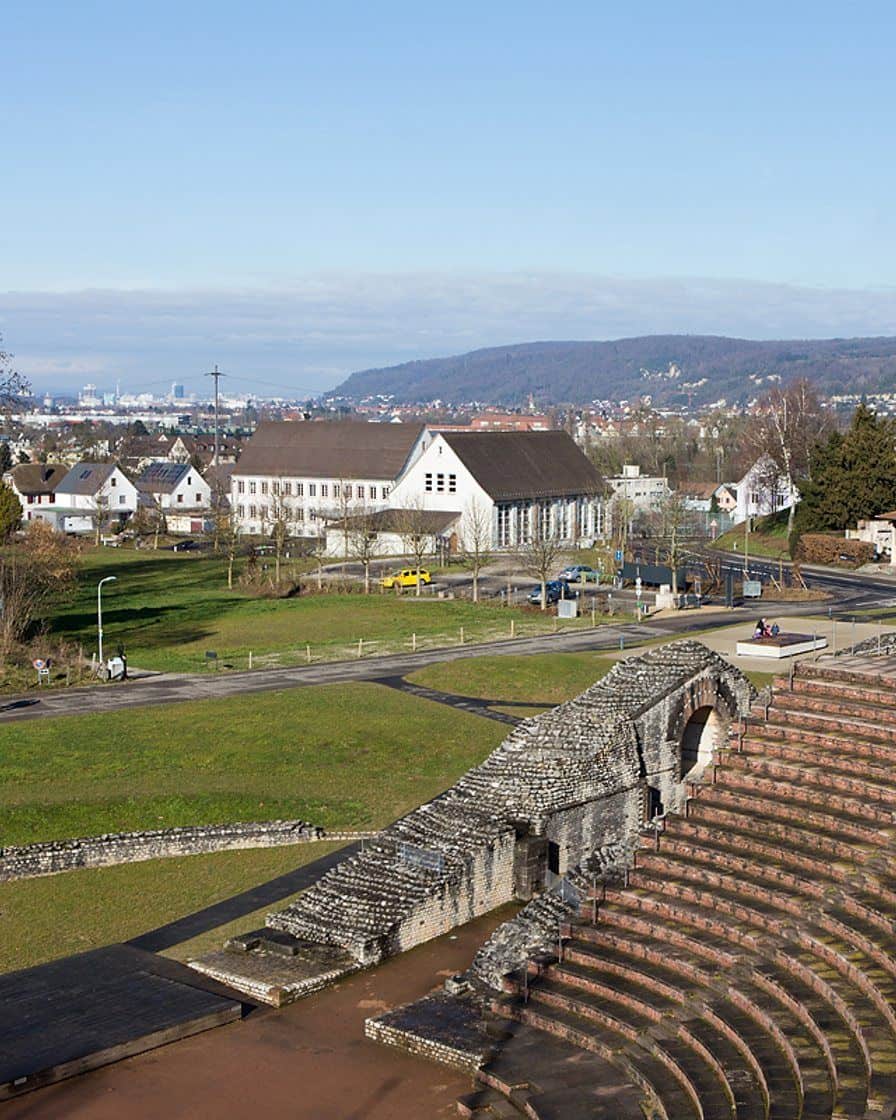
Photo: Roland Zumbuehl, CC BY 3.0, via Wikimedia Commons
Is the Ermitage in Arlesheim worth it?
The Ermitage is a romantic landscape garden with ponds, grottoes and viewpoints, not a museum. With tram 10 and a 10 to 20-minute walk, you are there in 35 to 55 minutes.
Allow 2 to 3 hours for a loop with breaks, 1.5 hours at least. The open-air site is largely free to enter, but individual grottoes or features may be closed without any calendar announcing it.
Arlesheim's cathedral and a meal in the village go well with it. Augusta Raurica on the same day does not: the combination comes to 6 to 8 hours door to door and falls apart as soon as you miss a connection.
Which half days are right on the doorstep?
Riehen is the easiest cultural outing: tram 6, then the Fondation Beyeler, with 2 to 3 hours for the exhibition and 3 to 4 hours with the park and café. What admission costs and how the time slots work is in Fondation Beyeler in Riehen.
Rheinfelden is reached by regional train, with the old town a few minutes from the station. For the lanes, the Rhine bridge and the riverbank, 3 to 5 hours are enough, longer with a meal or a swim.
The border divides Rheinfelden into a Swiss and a German town. That is appealing, but together they are not a major sight, and anyone expecting a monumental ensemble will be disappointed.
The Dreiländereck, the three-country point, is the most overrated outing. Take tram 8 towards Kleinhüningen, walk a little and you stand at the pylon where Switzerland, Germany and France meet; one to two hours are enough.
Around it are harbour facilities, roads and industry, not an Alpine panorama. As a symbol and a walk by the Rhine it works; as the main event of a day it does not.
Basel as a base: if you are planning two or three trips, stay near SBB station or in Kleinbasel near Badischer Bahnhof, depending on the direction. The well-rated places to stay in Basel bring the BaselCard with the visitor tax, covering trams and buses in the city zones and therefore the way to Riehen, Arlesheim and the Dreiländereck.
Compare places to stay in Basel →Partner link: booking through this link supports our editorial team at no extra cost to you.Colmar or Freiburg for a full day?
Both are genuine day trips, at 1.5 to 2 hours each way door to door. If you want to see both, take two days: there is no direct rail link between Colmar and Freiburg, and the border costs hours.
Colmar is on the French side: the TER from the French section of Basel SBB usually runs there without a change, via Mulhouse. On site, 5 to 7 hours make sense: in 3 to 4 hours you see Little Venice, the old town and a few lanes, but hardly the Unterlinden Museum, the covered market or a relaxed meal.
The most common mistake is trying to combine Colmar with Haut-Koenigsbourg Castle and Ribeauvillé. That works by car or coach; by train it turns into a chain of connections.
Freiburg im Breisgau is reached by train from Badischer Bahnhof or SBB station, and from the main station it is 15 to 25 minutes on foot to the main sights. Allow 1.5 hours for the old town, an hour for the cathedral and its square, one to two hours for the districts and city gates, and the rest for food, museums or the Schlossberg.
On market days the cathedral square is packed, and in summer the whole old town is. In rain the Bächle, the little street channels, and the walks lose their charm, while the museums save the day.
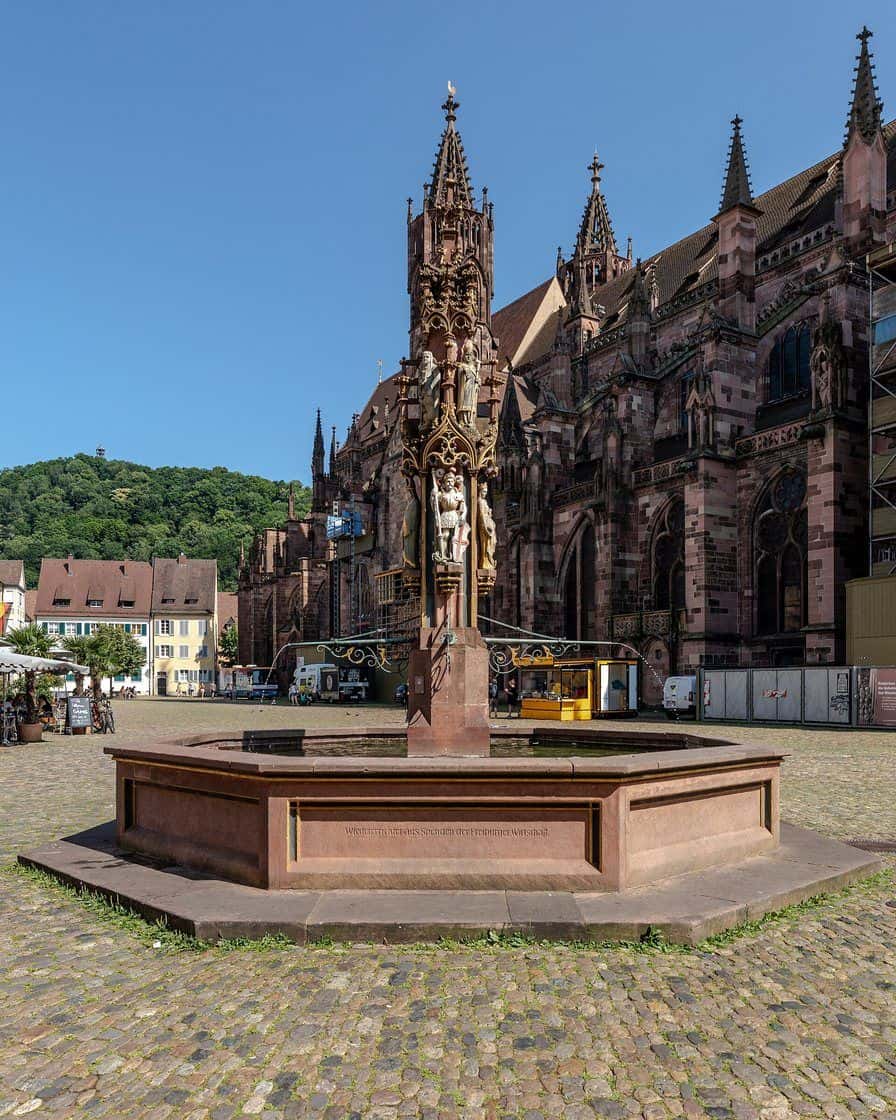
Photo: Dietmar Rabich, CC BY-SA 4.0, via Wikimedia Commons
When is Mulhouse the better choice?
Mulhouse is closer than the door-to-door table suggests: the train takes about 20 to 30 minutes, but because of the walk to the French platforms at Basel SBB and getting around town the trip still takes 1 hr 15 to 1 hr 45 each way. The city is not a second Colmar; its appeal lies in industrial history and museums.
The National Automobile Museum alone takes 3 to 4 hours, and the Cité du Train and the Textile Printing Museum 2 to 3 hours each. More than one big museum a day is not realistic, but Mulhouse is the best rainy-day choice among the day trips, just like the venues in Basel in the rain.
Are Lucerne, Bern and Zurich worth a day trip?
Bern is the best choice for a first Swiss city day: the old town, arcades, bear park and the Aare are close together, and 4 to 6 hours are enough. Zurich is more spread out and more expensive, and anyone planning several museums or a lakeside walk underestimates the distances.
Lucerne means 4.5 to 5.5 hours of travel there and back. The old town, the Chapel Bridge, the lake and one museum are doable; adding Pilatus or Rigi turns it into a 10 to 12-hour day that costs a lot and shows little in bad weather.
The rule for all three: one city a day, never two combined. Anyone trying to see Bern and Lucerne in one day mostly sees train compartments.
Which tickets apply to day trips?
Guests at Basel accommodation receive the BaselCard, which according to TNW is valid in zones 10, 11, 13, 14 and 15 and explicitly not on cross-border journeys. For Riehen, Arlesheim and the Dreiländereck it is usually enough; for Colmar, Mulhouse and Freiburg, never.
- Riehen, Arlesheim, Dreiländereck: city and regional fares, free with the BaselCard depending on the zone.
- Augusta Raurica and Rheinfelden: Swiss regional fare; the machine shows the zone. If you stay in Basel-Landschaft, the Gästepass+ covers regional transport.
- Colmar and Mulhouse: cross-border rail ticket, bought separately.
- Freiburg: international ticket or a cross-border offer.
- Bern, Zurich, Lucerne: normal Swiss rail ticket; no guest card covers these routes.
For the TNW day pass, two sources give 20.20 CHF and 18.20 CHF, and neither explains the difference. There is no single regional pass price covering every trip; all guest cards and day passes are compared in BaselCard and Mobility Ticket.
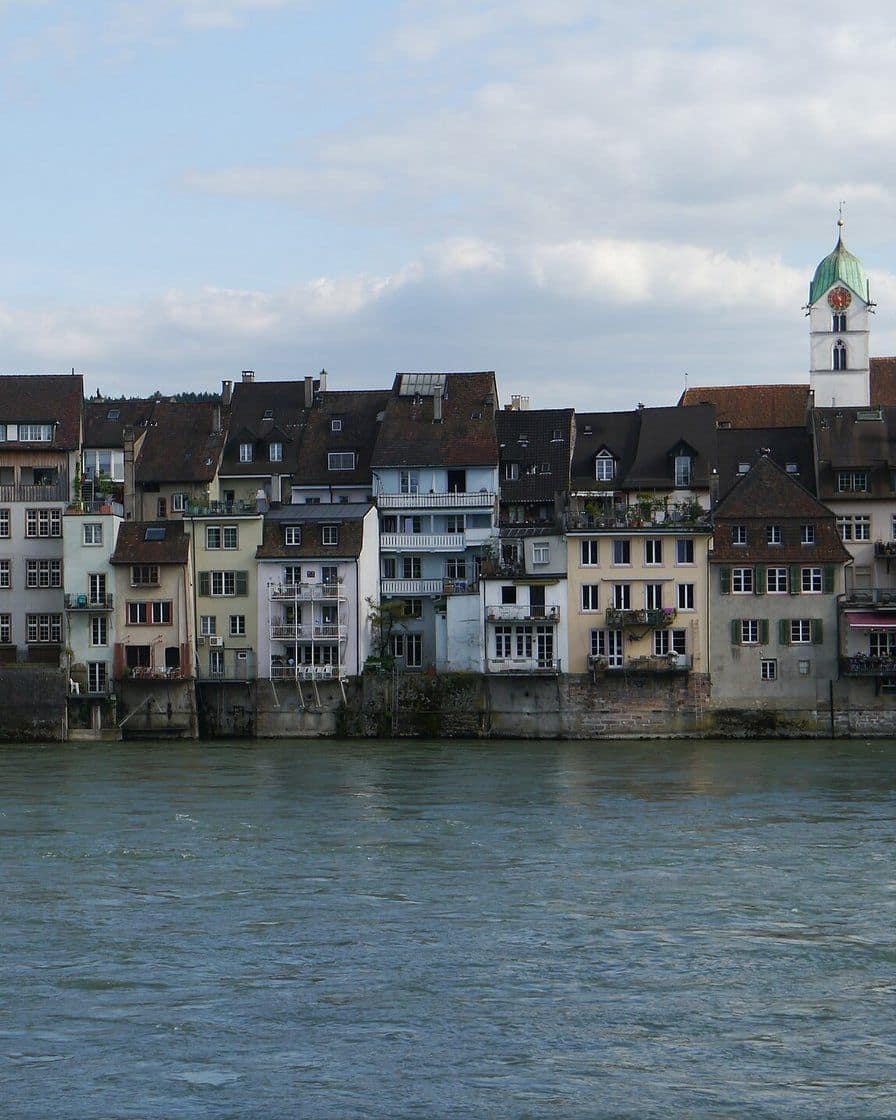
Photo: Zairon, CC BY-SA 3.0, via Wikimedia Commons
Which combinations work, and which do not?
- Riehen and Basel: very good, with the Fondation in the morning.
- Arlesheim and central Basel: a coherent half day.
- Augusta Raurica and Rheinfelden: possible, but a long day of 7 to 9 hours.
- Colmar alone, Freiburg alone, Mulhouse alone: each is the right day.
- Colmar and Freiburg, Colmar and Mulhouse: fail because of the border and the timetable.
- Arlesheim and Augusta Raurica, Dreiländereck and Riehen: close on the map, far apart in the timetable.
If you need to trim an overloaded programme, cut in this order: the Dreiländereck, the second museum in the same city, the village added to Colmar, the mountain at Lucerne in uncertain weather, and one of the two cities across the border.
What changes with the season and the weather?
In rain: the Fondation Beyeler, the Mulhouse museums, the Roman Museum at Augusta Raurica, the museums in Colmar or Zurich. Cross off Arlesheim, the Dreiländereck and the open-air ruins.
In summer, Colmar, Lucerne and the old towns are full, as are cross-border trains at weekends. In the heat, ruins and riverbanks offer little shade, and Arlesheim and Riehen are more pleasant in the morning; temperatures by month are in the best time to visit Basel.
In autumn and winter the days are short, so Augusta Raurica and Arlesheim do not suit the late afternoon. During Advent, the Christmas markets in Colmar and Basel draw crowds and every journey time becomes too tight; more in Basel Christmas market.
What mistakes do visitors make?
- Two cities across the border in one day, because both are "under an hour" away.
- Confusing train time with trip time.
- Adding a museum to a city already planned as a half day.
- Not checking Mondays and public holidays, which differ in Switzerland, Germany and France.
- Crossing the border with the BaselCard.
- Booking an organised trip to save time and then having hardly any free time.
Leave early, back in the evening: for Colmar, Freiburg or Bern, what counts is accommodation within walking distance of the station. The mid-range hotels in Basel around SBB station and in Gundeldingen save you a tram ride every morning; districts and prices are compared in where to stay in Basel.
See hotels near the stations →Partner link: booking through this link supports our editorial team at no extra cost to you.Before you leave Basel: the city itself easily fills two days, as a weekend in Basel shows. The Vitra Campus across the border in Weil am Rhein is described in Vitra Campus in Weil am Rhein, every destination is marked on the map of Basel, and the tram lines are in getting around Basel.
Sources: Basel Tourism (day trips around Basel, in German, French and English), Northwestern Switzerland tariff network (tourist information, tariff conditions T651 2018 to 2024), rail operators' timetable data (train times, see Basel's stations), basel365 research (door-to-door guides and time on site, October 2026), museums.ch (Augusta Raurica, prices and opening hours).
Frequently asked questions
Which trips from Basel can you do in half a day?
How long does it take to get from Basel to Colmar?
Is the BaselCard valid for day trips?
Can you visit Colmar and Freiburg on the same day?
How much time do you need for Augusta Raurica?
Samuel Tschudin
Samuel spent eight years guiding groups through the Old Town, from Münsterplatz to the Rhine promenade. He builds his routes on foot, watch in hand, and cuts whatever does not fit into a real day. He would rather write that a visit is not worth the ticket than pad out a list.