Swimming in the Rhine in Basel: Wickelfisch, entry points, rules and safety
Drifting down the Rhine with a Wickelfisch is the quintessential Basel summer experience, but it is not a swimming pool. The thresholds the canton gives, where swimming is banned, what applies after rain and what you can enjoy on the bank without swimming.

In Basel, Rhine swimming means getting into the water on the Kleinbasel bank, clothes in a waterproof bag, drifting downstream with the current for a stretch and getting out further down. It is the city's most distinctive experience, free of charge, and it is not supervised bathing.
Current, boats, bridge piers and water temperature are part of it, and with them the risk. This page sums up what the canton recommends and prohibits, when the water is clean, how to use a Wickelfisch properly and what you can enjoy on the bank if you do not swim.
When can you swim in the Rhine?
In 2026 the Canton of Basel-Stadt gives three thresholds within which it recommends swimming. They are not a guarantee of safety but limits beyond which you should not go in.
| Measurement | Canton's recommendation |
|---|---|
| Water temperature | above 18 °C |
| Flow rate | below 1,500 m³/s |
| Water level | below 6.50 m |
On top come two basic rules: only if you are a strong swimmer, and never alone. The canton stresses that the Rhine is dangerous above all for inexperienced swimmers and children.
In June 2026 a Rhine swimmer died after resuscitation, and the canton repeated exactly this warning on that occasion. If it is your first time in the Rhine, go with someone who knows the river.
Where is swimming banned?
- Above and below the Birsfelden lock.
- In all harbour areas, and near weirs and hydroelectric plants.
- Jumping from bridges is prohibited.
- Air mattresses and other flotation aids are not allowed.
- Bridge piers: dangerous eddies form there, so keep your distance.
- The shipping channel, boats, buoys, landing stages and embankments: stay clear.
Basel Tourism recommends staying close to the Kleinbasel bank and avoiding the harbour and weirs. Look upstream regularly: boats coming from there are quiet and hard to manoeuvre.
Since 2020 the canton has advised against swimming on the Grossbasel side below the Elsässerrheinweg, that is towards the harbour and the border. Plan your exit further upstream rather than looking for one once you are in the water.
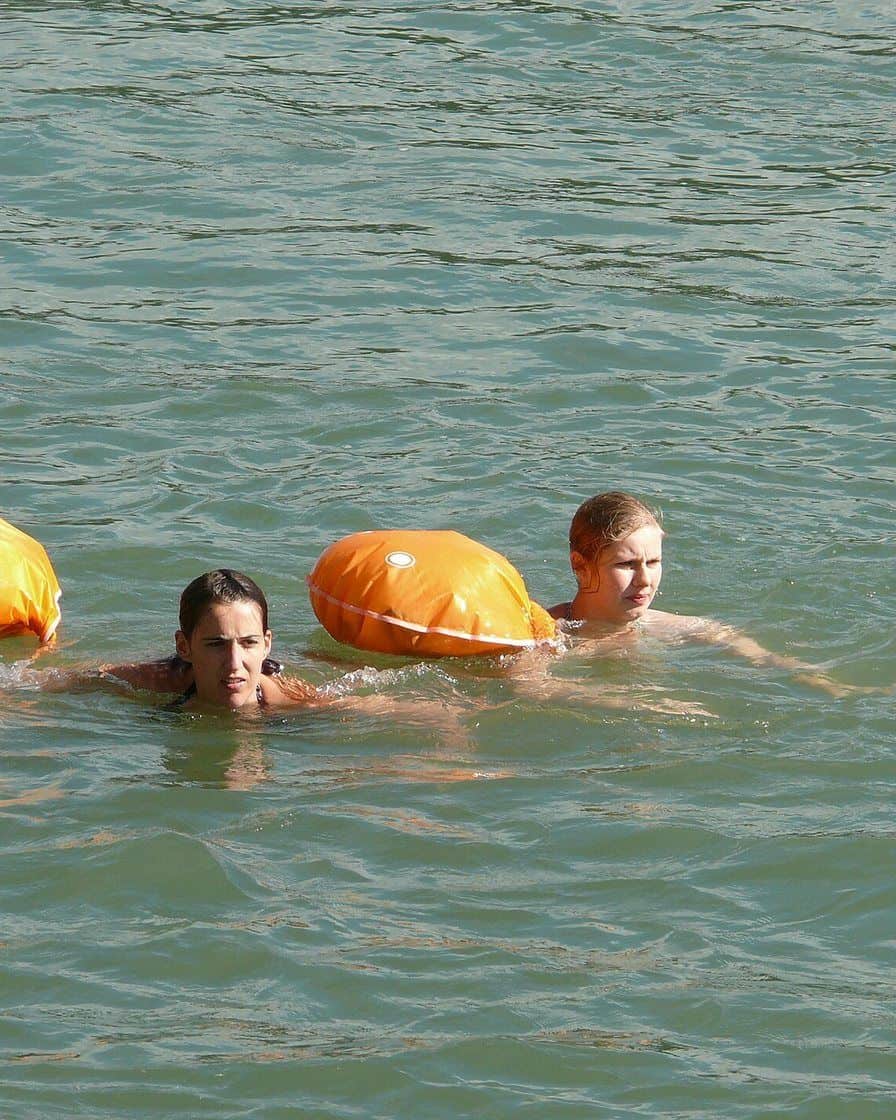
Photo: Fridolin freudenfett (Peter Kuley), CC BY-SA 3.0, via Wikimedia Commons
Where do you get in, and how long does it take?
Many descriptions name the Birsköpfli as the starting point, where the Birs flows into the Rhine above the city. The canton and the tourist office, however, publish no official route with distance, duration and recommended exit.
The Eglisee also often comes up in this context. It is an outdoor pool on dry land, not an entry point into the Rhine, and cannot be used as the start of a river stretch.
Giving a fixed duration would be misleading: it depends on the flow, the wind, the temperature, breaks and your own strength. Choose your stretch according to your fitness, get out too early rather than too late, and check your exit from the bank before getting in.
First time in the Rhine? From July to mid-September, lifeguards from SLRG Basel and Oberwil accompany a group down the Rhine every Tuesday evening, free of charge and with registration. The meeting point is below the Museum Tinguely at 5:45pm, by the blue flag of the sports office, and the group swims to the Wettsteinbrücke.
When is the water clean?
In stable, sunny weather the water quality in the Rhine is usually good, according to the canton. After rain it deteriorates quickly, the number of faecal indicators rises and with it the risk of germs, according to the review of the 2025 bathing season.
- Good days: several days of stable fine weather and all three thresholds met.
- Bad days: straight after heavy rain, during thunderstorms, during snowmelt in spring and early summer, and at high water with driftwood.
The canton also advises not to drink the water, not to dive and to shower after swimming. A hot day alone does not make swimming advisable.
The sources publish no table of average water temperatures by month, and we will not invent one. Air temperatures by month are in the best time to visit Basel, and the water temperature is something to check on the day.
What is a Wickelfisch, and how do you use it?
The Wickelfisch is a waterproof, fish-shaped bag for clothes and small items during your drift down the Rhine. You roll the top over several times, seal it and hold it in your hand as you swim.
- In it: clothes, a light towel, keys, a small purse, and your phone in an extra pouch.
- Not in it: anything that cannot tolerate a drop of water. The bag reduces the risk; it is not diving equipment.
- Prohibited: tying the bag around your body or using it as a flotation aid.
We found no reliable confirmation of 2026 prices, outlets, sizes or colours. Ask at Basel Tourism, in the pools or at the riverside buvettes, and do not confuse the Wickelfisch with any old dry bag.
The Rhine in the morning, the city in the afternoon: if you are coming to swim in summer, stay in Kleinbasel, with the riverbank on your doorstep and no wet clothes on the tram. The well-rated places to stay in Basel for late July 2027 can be filtered by location, and for a day by the river there are also tours and activities in Basel, some of them on the water.
See places to stay for summer →Partner link: booking through this link supports our editorial team at no extra cost to you.What do the Rhine baths, buvettes and ferries offer?
The Rhine baths and buvettes on the bank are good for a break, a drink or getting into the water. They do not replace supervised bathing, and whether they open depends on the weather.
Opening hours, prices and closing days for 2026 are not published centrally. A buvette may be closed in bad weather or out of season without any general page announcing it, so if you want to eat there, have a plan B, as eating in Basel shows.
Basel's four ferries hang from a cable and cross the Rhine driven by the current alone. A crossing is short, needs no booking and is paid on board: CHF 2 for adults, CHF 1 for children.
In wind, high water, technical trouble or out of season, a ferry may stop running. One of them, the Münsterfähre, docks below the Pfalz; more in Basel Minster.
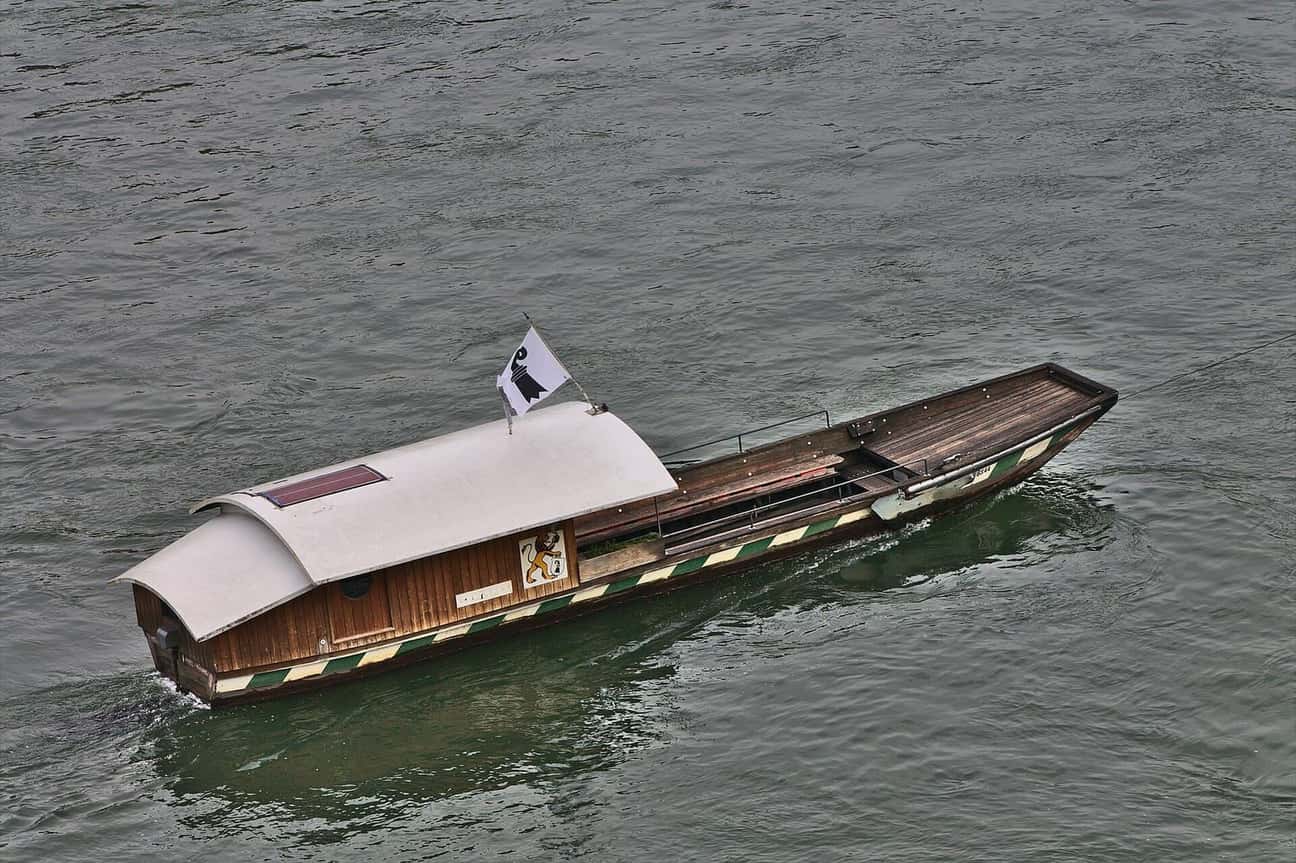
Photo: Jacek Rużyczka, CC BY-SA 4.0, via Wikimedia Commons
What does a day by the Rhine cost?
Swimming itself costs nothing, as there is no ticket for the river. The costs come around it: tram, Wickelfisch, a drink at a buvette, the ferry, a locker or a pool.
Guests at Basel accommodation ride the tram to the Birsköpfli and back for free with the BaselCard, as explained in BaselCard and Mobility Ticket. There is no combined pass for the Rhine, the ferries and the museums.
When is the best time?
- 1.5 to 2 hours: the riverbank, watching the swimmers, a buvette or a ferry.
- 3 to 4 hours: a walk, a swim, drying off, food or a drink.
- A whole day: the Rhine in the morning or late afternoon, with a museum in between.
In the late morning and afternoon the water is warmer and the buvettes are more likely to be open. Early in the morning it is quieter, but cooler.
During Art Basel, from 17 June 2027 to 20 June 2027, afternoons and evenings on the bank are busiest. If you want to swim that week, get in the water early and go to the fair in the afternoon; see Art Basel.
What do the pictures not tell you?
- The Rhine is not a pool: changing currents, quick fatigue, underwater obstacles, boats and eddies.
- Rain changes everything: a hot day after a thunderstorm is not a good swimming day.
- Little room on the bank: clothes, bags, towels and bikes in a small space, and changing without a cubicle.
- Nothing is guaranteed to be open: buvettes and ferries close depending on the weather, the water level and the season.
The canton publishes the main rules in English and French too, and Basel Tourism's page is in English. Closures and short-notice notices posted on site, however, are often in German only.
What can you do on the bank without swimming?
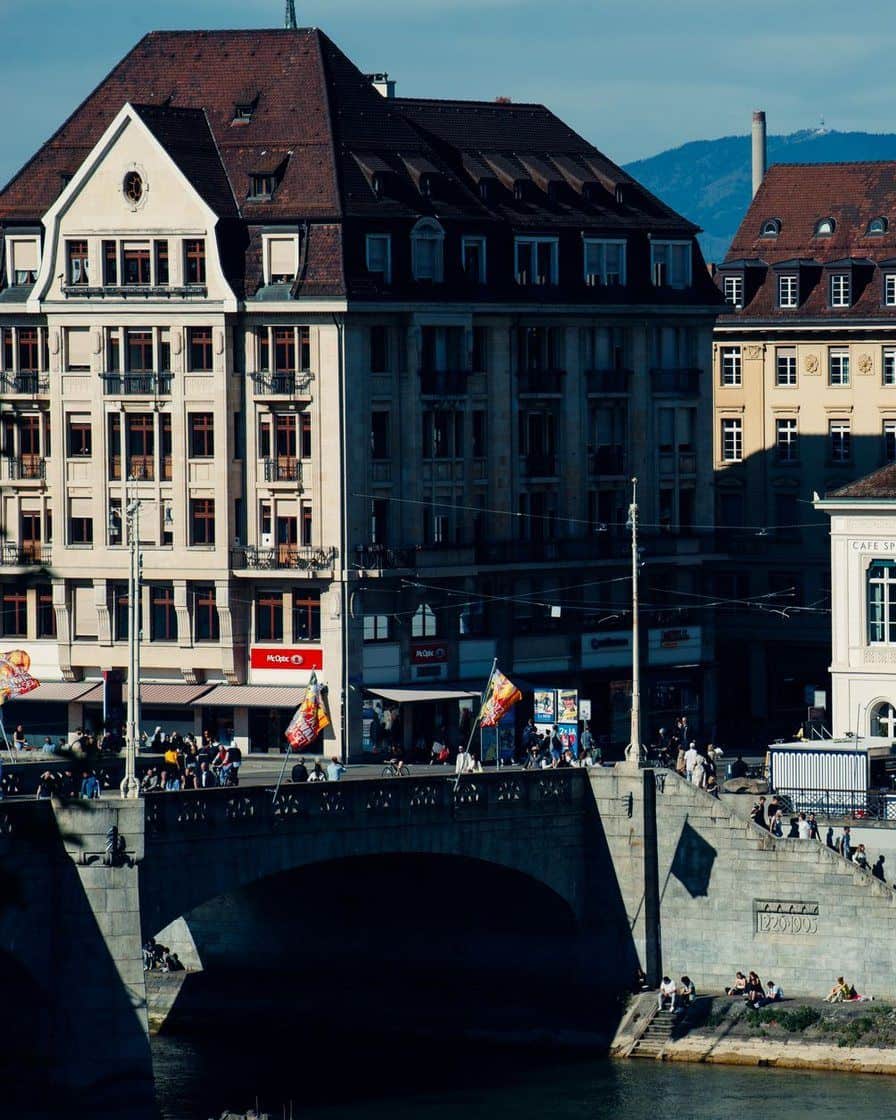
The Kleinbasel bank is worth it dry too: views of the Old Town, terraces, buvettes and the evening atmosphere. It is not a beach, though; access is urban, the banks are uneven and they are crowded on fine evenings.
A good loop crosses the Mittlere Brücke, follows the Kleinbasel bank and returns by ferry, as described in the Old Town walk in Basel. In July you can combine the river with the Basel Tattoo at the Kaserne, right by the water.
For rainy days there is Basel in the rain, and for every other idea things to do in Basel. The riverside district, Kleinbasel, is described in where to stay in Basel.
Sources: Canton of Basel-Stadt (the Rhine, in German, English and French, 2026; Rhine water quality from a swimmer's perspective, 2023; bathing water quality 2025, published 2026; press releases 2019, 2020 and June 2026; cantonal laboratory, bathing tips), Basel Tourism (Swimming in the Rhine).
Frequently asked questions
Is Rhine swimming allowed in Basel?
What is a Wickelfisch?
Where do you get into the Rhine in Basel?
Is the Rhine water in Basel clean?
Does Rhine swimming cost anything?

Samuel Tschudin
Samuel spent eight years guiding groups through the Old Town, from Münsterplatz to the Rhine promenade. He builds his routes on foot, watch in hand, and cuts whatever does not fit into a real day. He would rather write that a visit is not worth the ticket than pad out a list.